

Xtracars®® Blog
Car Tips and Tricks
Defensive driving: 6 techniques for safer journeys in Portugal
Before looking at the main defensive driving techniques, it is worth clarifying what the term means. What does it actually mean to drive defensively?
For Xtracars, defensive driving is a driving style based on specific techniques that help improve the safety of everyone in the vehicle. It involves driving with the aim of preventing risks, avoiding hazards and reducing the likelihood of accidents, regardless of the conditions - whether poor road surfaces, adverse weather, or unsafe behaviour from other drivers or pedestrians.
What makes a good defensive driver?
Now that we’ve defined defensive driving, let’s look at what characterises a defensive driver. Responsibility is the main trait: a defensive driver understands the risks linked to distraction, tiredness, stress and emotional state.
A defensive driver is also someone who adopts a cautious approach. A defensive driver treats every journey as one that requires attention, even on familiar daily routes.
Finally, thoughtful driving stands out as a key trait. The explanation is simple: whenever this type of driver gets behind the wheel, they are fully aware of their actions, taking into account factors such as road conditions, visibility, traffic and weather.
With these characteristics in mind, here are six defensive driving techniques to apply on the road.
Anticipate dangerous situations
When approaching busier streets, particularly near schools, shopping areas or petrol stations, you should increase your level of attention. At junctions, be mindful of traffic coming from side roads so you can react defensively if necessary.
Stay alert to pedestrians, cyclists, runners and, of course, other drivers, ready to brake safely if needed. Your rear-view mirror is essential for anticipating overtaking manoeuvres. Additionally, when encountering poorly parked vehicles or cars stopped in double-parked cars, near crossings or junctions, it’s crucial to slow down.
This makes it easier to spot whether a pedestrian or vehicle is about to move into your path.
This makes it easier to spot whether a pedestrian or vehicle is about to move into your path.
Use indicators and hazard lights correctly
It may seem obvious, but it’s often overlooked: whenever you intend to overtake, park, change direction or stop, you must signal your intention using your indicators or hazard lights. While this is required under the Highway Code, it is equally important to ensure that other drivers and pedestrians understand your intended manoeuvre.
Use your mirrors and check blind spots
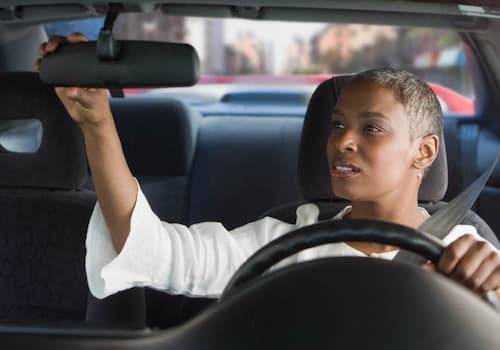
For defensive driving, mirrors are an essential tool. They provide a broad view of what is happening around the vehicle, particularly at the sides and rear.
However, remember the existence of blind spots - areas your mirrors cannot cover. Before making any manoeuvre, always check both sides to ensure no vehicle is in your blind spot.
Keep a safe following distance
You should always maintain a safe distance from the vehicle in front. This ensures better visibility and gives you enough time and space to react.
Although there is no universal minimum safe distance, it is essential for the driver to judge a gap that is sufficient to prevent accidents.

Communicate with other drivers
It may not be as unusual as it first seems. In certain situations, it can be difficult to tell whether other drivers have noticed your signals. In such cases, hand gestures can help communicate your intention to carry out a manoeuvre.
There are other ways to communicate too: light and sound signals are often effective and can be complemented by gestures when necessary.
Adjust your driving position before setting off
When sitting behind the wheel, it is essential that your position allows you to remain focused, comfortable and able to access all key controls.
Your arms and legs should be slightly bent, your back against the seat at roughly a 90-degree angle, the headrest aligned with your eye level, and the mirrors adjusted so that you do not need to move your head excessively to spot hazards.
To avoid unnecessary distractions, switch off your mobile phone whenever possible and keep music at a reasonable volume. As for seat belts, the rule is simple: everyone must wear one, without exception.
Defensive driving tips for visitors used to left-hand traffic
If you’re from the UK, Ireland, Australia or South Africa, pay close attention to this section. For those used to driving on the left, an adjustment period is normal when driving on the right.
What should you do? Increase your level of attention, especially at roundabouts, junctions and when changing direction, where ingrained habits from your home country may catch you off guard. Stay focused on the correct lane, follow road signs and observe the behaviour of other drivers whenever possible.
One final and important tip: always remember to look to the left first when entering a road.
Driving in Portugal: key road and traffic considerations
To make your defensive driving strategy truly effective, it is important to understand some of the key characteristics of driving in Portugal.
When approaching roundabouts, you must always give way to vehicles already circulating from your left. While this may not feel intuitive to all international drivers, it is a fundamental rule of Portuguese road traffic and requires constant attention.
Motorways also have their own particularities. Although the standard speed limit is 120 km/h, drivers should remain aware of speed enforcement cameras. In certain areas, lower speed limits may apply, requiring you to reduce your speed to as little as 80 km/h.
If your itinerary includes major cities such as Porto and Lisbon, be prepared for heavy traffic congestion and, equally importantly, the narrow streets commonly found in historic urban centres.
For journeys through Portugal’s rural interior, different challenges may arise. Mountain roads can be winding, narrow and, in some cases, lack safety barriers, demanding greater caution and concentration.
It is also essential to adapt your defensive driving techniques to seasonal weather conditions. Winters in Portugal are often wet and rainy, making road surfaces slippery and increasing stopping distances. Fog is another common hazard, particularly in mountainous regions, where visibility can deteriorate rapidly.
During the warmer months, temperatures can become extremely high. Pay close attention to your vehicle’s performance, including engine temperature, coolant levels and tyre condition. At the same time, monitor your own alertness and concentration, as prolonged exposure to heat can contribute to driver fatigue during long journeys.
Travel safely with Xtracars
Car hire with Xtracars takes you further, for as long as you need - and always safe. Choose the car you want to drive and the duration of your subscription. We’ll take care of the rest. Hit the road with a simple, hassle-free solution.